After 10 Years of Big Toe Arthritis, She Could Finally Wear Her Shoes Again
She had shoes in her closet that she had not worn in more than ten years.
But the loss that bothered her most was not really about the shoes themselves. It was about getting through a full retail shift without her big toe joint dominating every step. It was about walking into church wearing something she had chosen because she felt good in it, not because an arthritic joint had made the decision for her.
By the time she came to see me, big toe arthritis had been shaping her life for years. She worked on her feet and needed dependable function, not an abstract increase in a range-of-motion measurement. She wanted to wear regular shoes again. She wanted to stand through work without significant pain. And she wanted the freedom to dress for church without organizing everything around her foot.
Those were her destinations. The surgical decision had to begin there.
First, I needed to understand what the joint was still capable of
Before we discussed an operation, I asked her what she wanted her foot to allow her to do again. That conversation mattered because arthritis does not create the same problem for every patient. A person who stands for full shifts, someone hoping to return to yoga, and someone who wants comfortable daily walking may each place a different value on motion, certainty, footwear, and recovery.
I examined where her pain occurred as the big toe moved, how much useful motion remained, and what the imaging showed about the arthritic joint. The goal was not to preserve the joint simply because preservation sounded preferable. It was to decide whether the native joint retained a reasonable opportunity to provide comfortable, functional motion if the true sources of obstruction and compression were addressed.
Her case required more than removing a visible bump.
Root: the spur was part of the problem, but not the whole problem
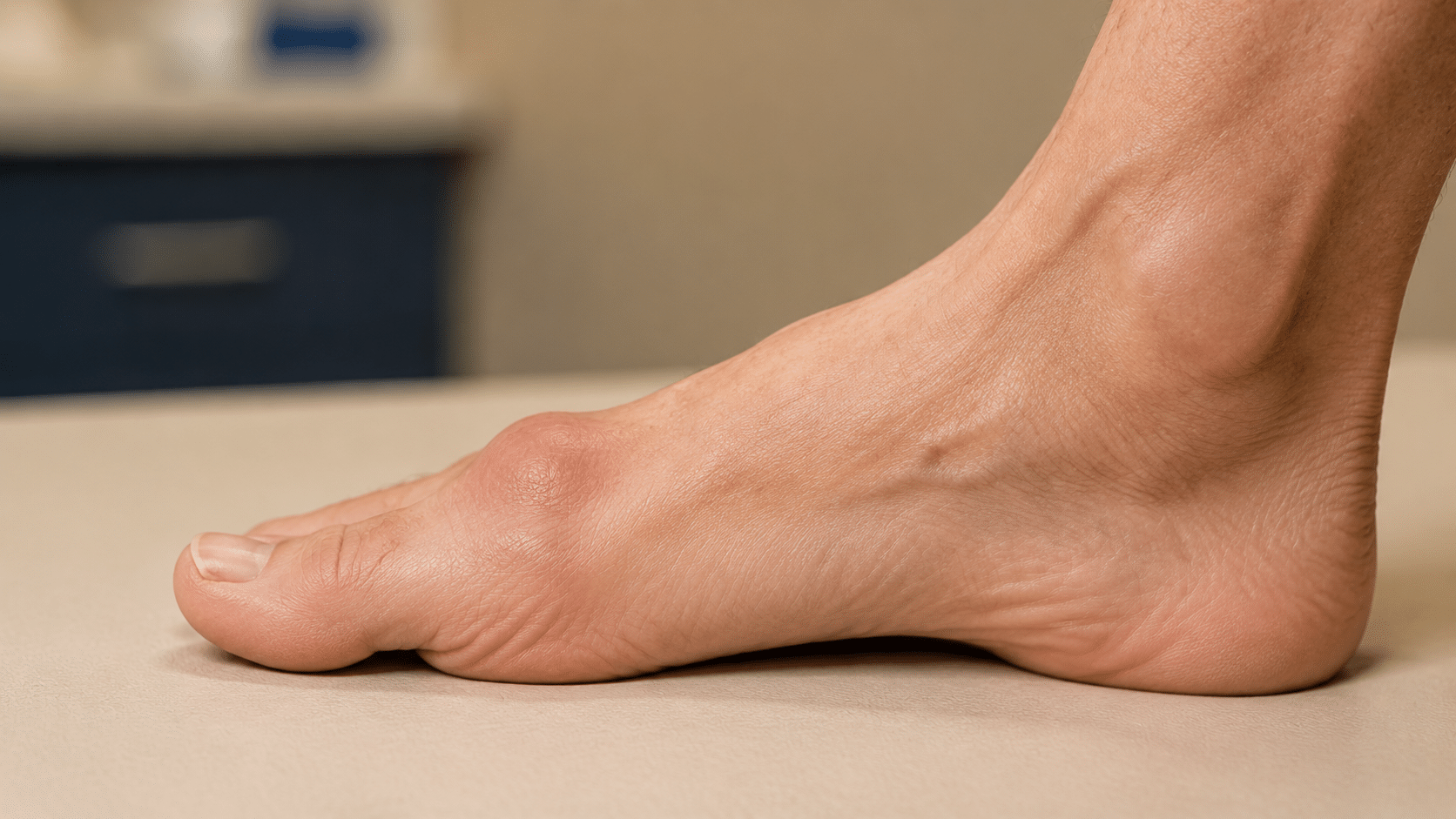
In big toe arthritis, a dorsal bone spur can act like a mechanical doorstop. The toe moves upward until it jams against the spur, producing a sharp, painful block. A cheilectomy removes that obstruction and can be very effective when the pain comes primarily from end-range impingement.
But a joint can remain crowded even after the top of the obstruction is removed. If the underlying compression is not addressed, the procedure may create more motion without giving the joint enough functional space to use it comfortably.
That was the important distinction in her plan. I was not trying only to make the toe move farther on the operating table or to make the postoperative X-ray look cleaner. I needed to create space in which the joint could move with less pressure.
More motion is not automatically better motion. The goal is useful motion.
Fix: removing the obstruction and decompressing the joint
Her reconstruction combined a thorough cheilectomy with meaningful joint decompression. I removed the obstructing arthritic bone and performed a modified decompression osteotomy based on a bunion-type bone cut. In plain language, the osteotomy changed the relationship within the joint so that the bones had more functional space rather than continuing to press against one another in the same crowded position.
This was still joint-preservation surgery. The objective was to retain her native big toe joint and the motion it could still provide, while reducing the mechanical conditions that made that motion painful.
The operation was only the structural part of the plan.
Heal: PRISM™ orchestrated the complete recovery plan
PRISM™ is not something added after I choose an operation. It is the surgeon-led orchestration of the entire case: understanding the problem, performing the correction, supporting healing, protecting the mechanics, and guiding recovery toward the patient’s destination.
For this patient, I designed and orchestrated PRISM™ around the condition of her arthritic joint, the demands of the reconstruction, her healing profile, and the life she wanted to regain. The goal was not to add a predetermined list of treatments to an operation. It was to make every part of the correction and recovery work together as one individualized plan.
Every part of that plan served the same goal: giving the preserved joint the best reasonable opportunity to function in the life she wanted back.
Her early recovery was harder than usual
Her early postoperative pain was more significant than most patients experience in my practice. It would be misleading to tell this story as if the recovery were painless simply because the final result was good.
One plausible contributor was that an arthritic joint and its surrounding tissues can already be chronically irritated, while the work required to remove the obstructing bone and decompress the joint can temporarily intensify that sensitivity. Whatever the precise contribution in her case, the pain was real and she needed stronger prescription pain relief than my patients typically require.
We treated the pain, monitored her closely, and continued the recovery plan. My responsibility was not limited to performing the operation. When a recovery departed from the usual pattern, it was my responsibility to remain present, evaluate what was happening, and help her through it.
As the early surgical irritation settled, the benefit of the decompression became clearer. Her motion was strong and her pain continued to improve; the difficult beginning did not become the ending.
The result was measured in workdays, regular shoes, and church
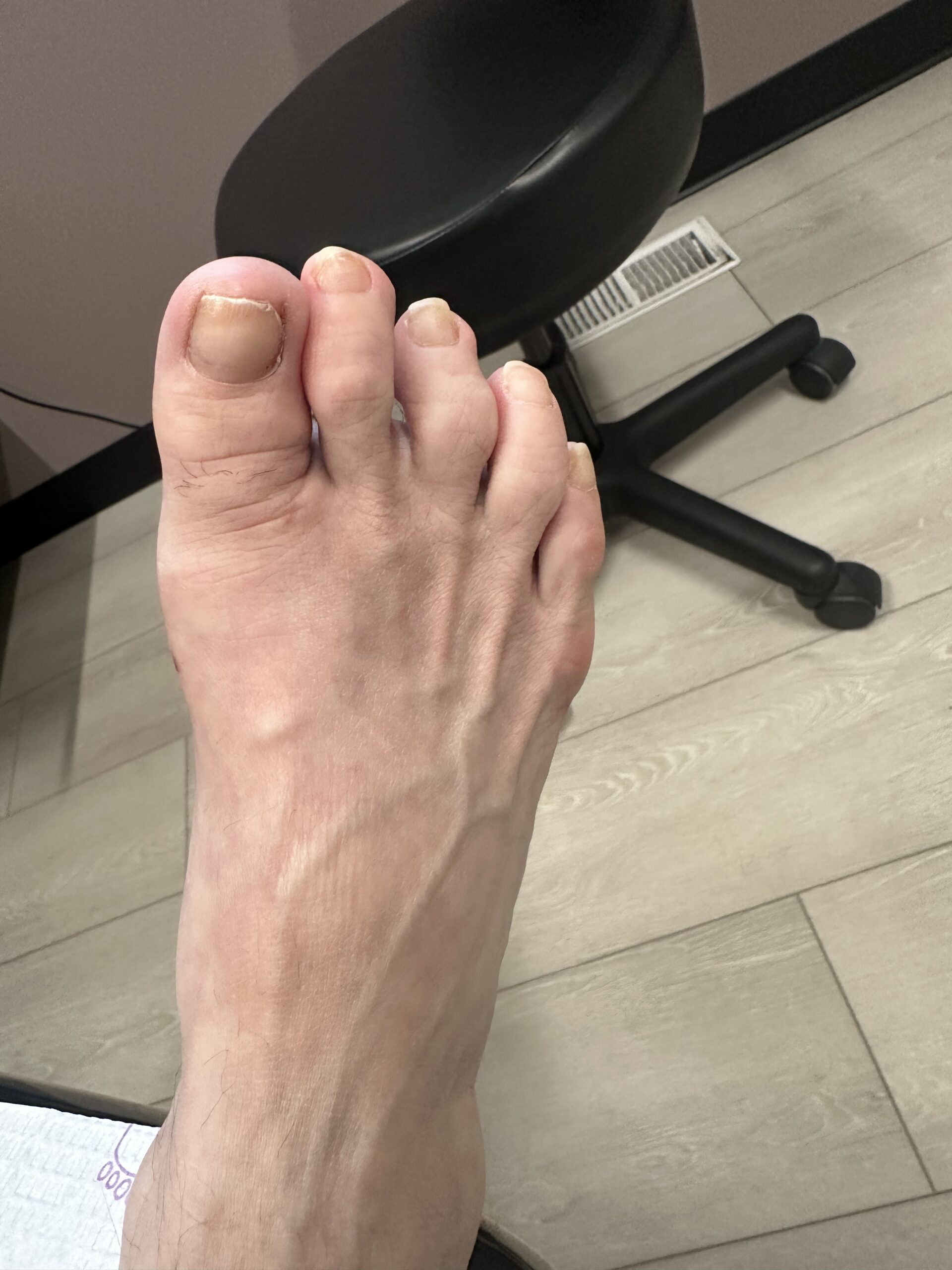
Ultimately, the structural correction healed successfully. She returned to regular shoes and could tolerate the demands of standing through her work shifts much more comfortably. The big toe had strong postoperative motion, but the number of degrees was not the result that mattered most to her.
The real result was the return of choice. She could wear regular shoes again, go to church in shoes she felt good about, and return to shoes that had remained unused for more than a decade.
Her own words say it most clearly:
“I’m now able to fit into shoes I haven’t worn in over 10 years.”
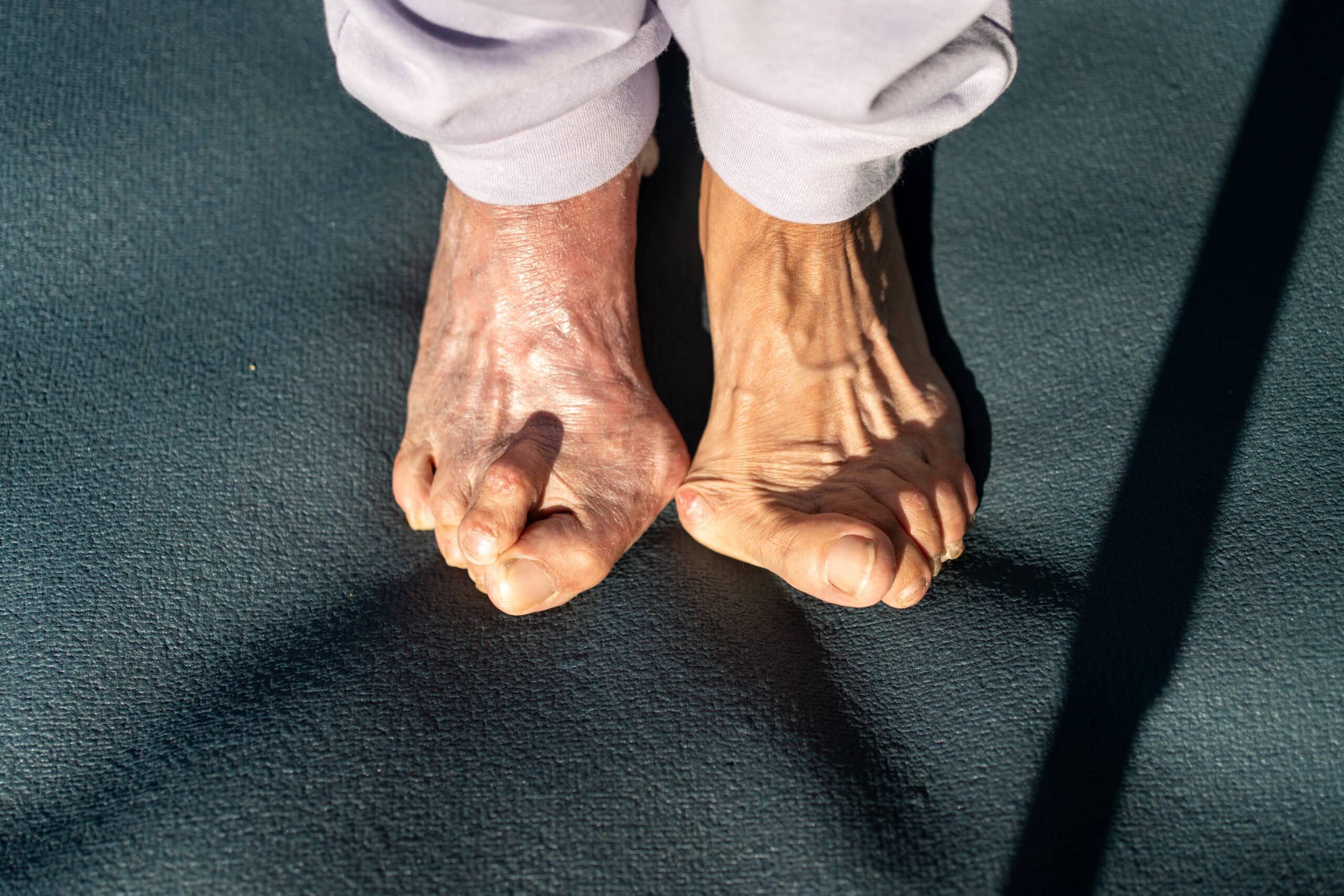
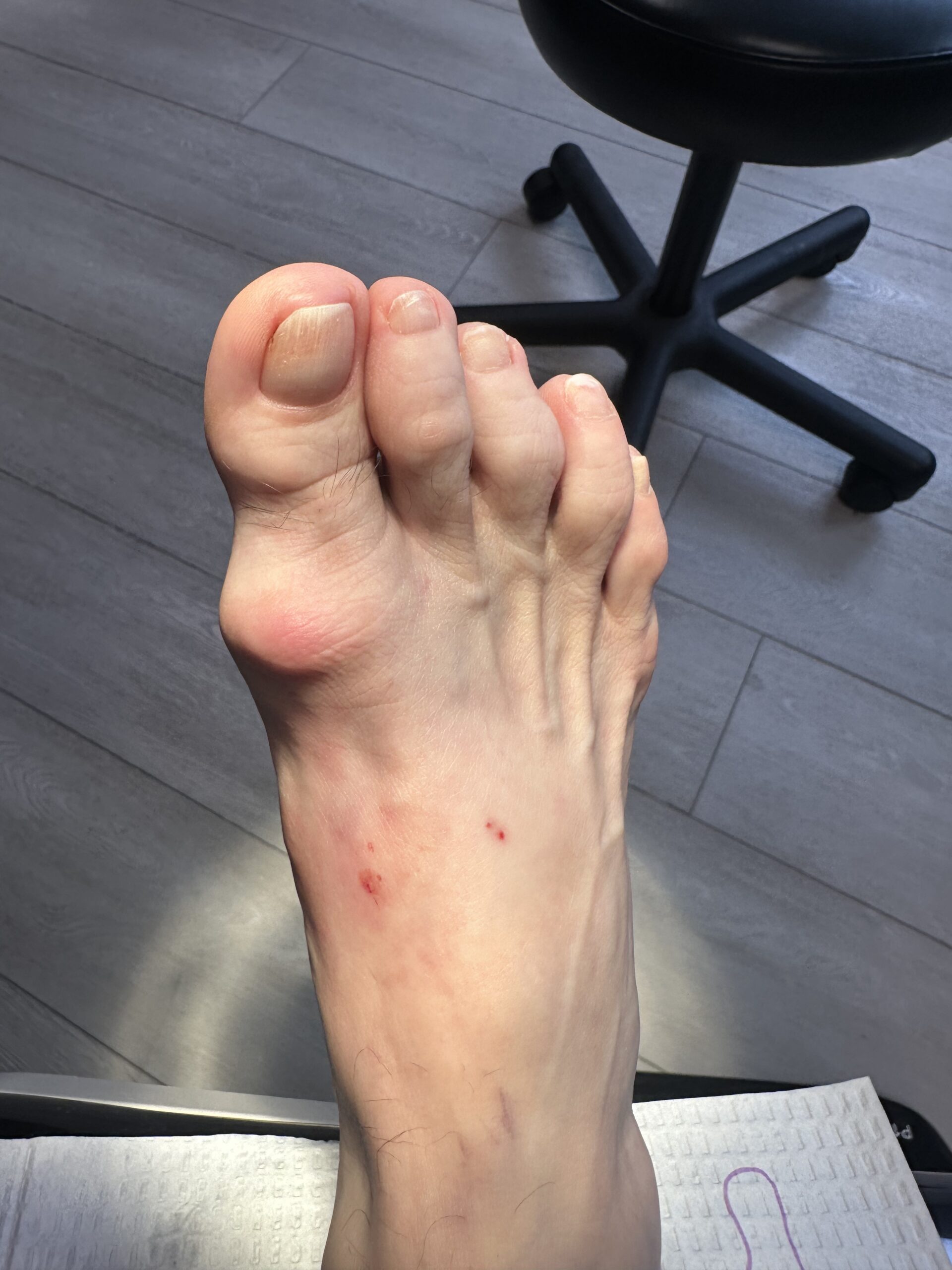
Actual before and after patient photos. Individual anatomy, treatment, recovery, and results vary."
Near the conclusion of her recovery, she offered a simpler assessment:
“Dr. Tagge did a fantastic job.”
I am grateful for the compliment, but what stays with me is the first quote. It describes what the correction meant in her actual life. The destination was never merely a larger range of motion. It was the ability to work, worship, dress, and move without letting arthritis make every decision for her.
Why this story does not mean every arthritic joint should be preserved
This result does not establish that every patient with big toe arthritis should have the same operation. Joint preservation contains uncertainty. Pain throughout the entire range of motion, substantial grinding, advanced cartilage loss, poor remaining motion, bone quality, and the patient’s priorities can all change the recommendation. Fusion or joint replacement may be more appropriate when the native joint no longer has a reasonable opportunity to provide useful function.
The lesson from her story is not that fusion should always be avoided. It is that the decision deserves more than a glance at an X-ray or removal of the most visible spur. It deserves an understanding of why the joint hurts, what the patient needs it to do, and whether the obstruction, compression, biology, and mechanics can be addressed together.
Read the complete guide to preserving the natural joint in big toe arthritis
A different kind of surgical decision
Many patients who come to me are accustomed to seeking in-network care and have received reasonable treatment within that system. They begin looking outside it when the problem has not been solved completely, when the available conversation feels limited to a single procedure, or when they want deeper analysis of the structural cause, the recovery, and the life they are trying to protect.
My practice is cash-pay and out of network because the work is designed around a different level of integration. The surgical and recovery plan is individualized and orchestrated by the surgeon around the patient’s goals, risk profile, healing needs, and desired outcome, then carried forward with surgeon-led continuity. The reason to choose this model is not simply access to an operation. It is access to the judgment and complete system surrounding it.
That distinction does not make conventional care wrong. It means that some patients reach a point where they want a broader answer than isolated treatment has provided.
Start by defining where you want to go
If big toe arthritis is determining which shoes you wear, how long you can stand, or which parts of your life still feel available to you, the first step is not choosing a procedure. It is determining whether the joint remains reasonably preservable and what outcome would make treatment worthwhile for you.
Dr. Michael Tagge reserves 90 minutes for each initial surgical consultation. This surgeon-led evaluation considers your pain pattern, imaging, remaining motion, mechanics, treatment options, and the tradeoffs among preservation, replacement, and fusion. It is not a commitment to surgery; its purpose is to determine which path, if any, best fits the joint and the life you want it to support.
Request a comprehensive surgical consultation
Learn about the PRISM™ Reconstruction System
Medical and results note
This Recovery Story describes one patient’s experience. Her treatment was individualized, and her recovery included more early pain than is typical in Dr. Tagge’s practice. Individual anatomy, arthritis severity, procedures, recovery, and results vary. The story is educational and does not guarantee a comparable outcome.