Minimally invasive surgery changes how the correction is performed. PRISM™ changes how the entire surgical journey is designed.
Most patients who come to see me are not simply looking for someone who can correct a bunion. By the time they reach my office, they usually already know that surgery exists.
What they are trying to understand is whether there is a way to fix the problem without surrendering months of their life to the recovery.
They worry about pain, being unable to walk, crutches, large incisions, permanent hardware, time away from work, losing fitness, needing help from family, or simply becoming dependent while they heal.
Those concerns are reasonable, because for many years that was the experience people associated with bunion surgery.
Modern minimally invasive surgery has changed a great deal of that. But I believe the evolution of bunion surgery should go one step further.
That is why I developed the PRISM™ Reconstruction System.
PRISM is not simply another bunion operation. It is the framework I use to design the correction, healing environment, stability, biomechanics, and recovery together around one central question:
What does this patient need this foot to do when we are finished?
If you are still deciding whether your bunion has reached the point where treatment makes sense at all, I recommend starting with my Complete Bunion Decision Guide: When to Wait and When to Act.
The Evolution From Traditional Surgery to Minimally Invasive Surgery to PRISM™
Traditional bunion surgery was primarily designed around correcting the deformity. The surgeon selected an operation, exposed the bone through a larger incision, corrected the alignment, stabilized it, and then allowed the tissues and bone to recover.
That model can produce excellent structural correction, and traditional open procedures remain appropriate in certain situations. But the operation itself often creates a significant recovery burden.
Minimally invasive surgery changed that equation.
By performing the necessary bone correction through very small incisions, we can reduce unnecessary soft-tissue disruption while still making meaningful changes to the underlying structure of the foot. In my practice, that has allowed me to approach many forefoot deformities very differently from the way patients traditionally imagine foot surgery.
But minimally invasive surgery is still a technique.
It tells us how the structural correction is performed. It does not, by itself, address every other variable that influences what happens before, during, and after surgery.
That distinction is the foundation of PRISM.
I think of the progression this way: traditional surgery focused primarily on the correction. Minimally invasive surgery improved how we perform the correction. PRISM™ is designed around the entire outcome.
A Successful Operation Is More Than a Corrected X-Ray
Surgeons naturally pay close attention to X-rays. We should. Alignment matters.
But a technically excellent postoperative X-ray does not tell the entire story of whether an operation was successful for the person who had it.
The correction still has to heal. It has to remain stable while healing occurs. The patient has to get through the recovery. The reconstructed foot ultimately has to tolerate the mechanical demands of walking, exercise, work, travel, and everyday life.
Most importantly, the result has to solve the problem the patient actually came in asking me to solve.
That is why one of the most important questions I ask is not simply, “What procedure corrects this bunion?”
It is, “What is this person trying to get back to?”
For one patient, that may mean walking through Europe without thinking about her foot every afternoon. Another wants to return to tennis. Someone else wants to wear shoes she has avoided for ten years. Another simply wants to get through a normal workday without continually adjusting how she stands and walks.
The X-ray helps me understand the structure.
The patient tells me the destination.
The surgical plan has to respect both.
This philosophy is also why I believe patients should understand the most important questions to ask before choosing foot surgery or a surgeon.
Surgery Is One Event. Recovery Is a Process.
One of the ideas that most strongly shaped PRISM is actually very simple: surgery happens on one day, but the outcome develops over weeks and months.
I do not believe recovery should be something we discover after the operation.
It should be part of the plan before I make the first incision.
Before surgery, I am already considering how much correction is necessary, how stable that correction needs to be, what the patient’s underlying healing capacity looks like, how soon protected mobility can begin, what demands they will face at home or work, and ultimately what needs to happen for them to return to the activities that matter to them.
The procedure is important. It may be the decisive event that changes the structure of the foot.
But it is still only one event inside a much larger treatment process.
That larger process is PRISM.
ROOT → FIX → HEAL
The easiest patient-facing way to explain PRISM™ is through three stages: Root → Fix → Heal.
They are not separate treatments. They are three parts of the same decision-making process.
ROOT: Understand Why the Problem Exists
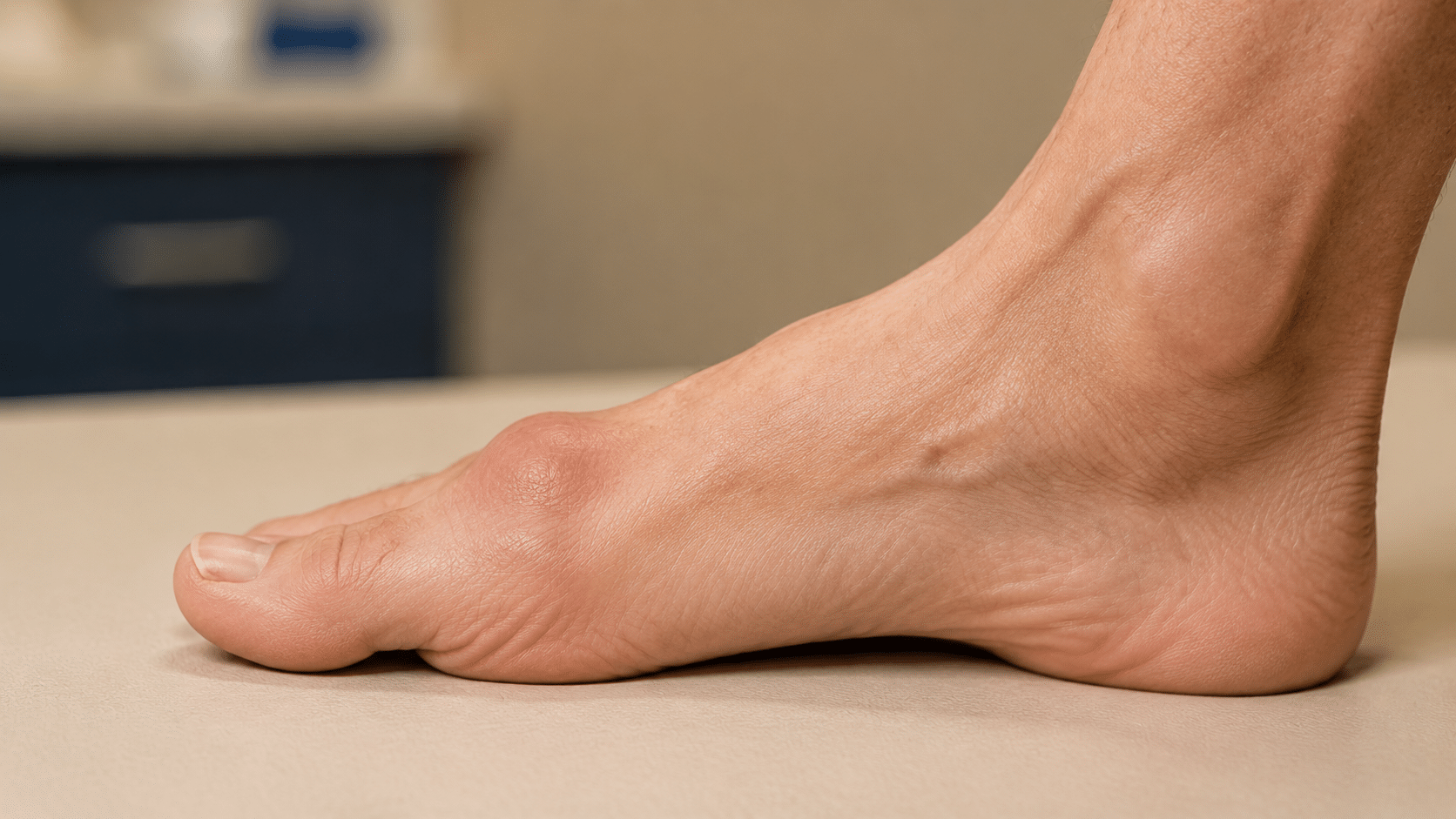
A bunion is visible as a bump along the inside of the foot, but the bump is not the whole problem.
I want to understand what is happening across the entire forefoot. How is the great toe functioning? Where is pressure being transferred? Are the lesser toes compensating? Is the joint becoming stiff? Is the patient changing the way she walks? Are there other deformities contributing to the problem?
I also want to understand the person attached to that foot.
What has she stopped doing? What does she want to return to? What is she most afraid of losing during recovery? What would make the treatment worthwhile to her?
Those questions influence the operation just as meaningfully as the angles on the X-ray.
If you want a deeper explanation of the mechanics behind the deformity, read why bunions develop and how foot mechanics influence progression.
FIX: Perform the Correction That the Patient Actually Needs
Once I understand the root problem and the desired destination, I can determine what correction is appropriate.
That may involve repositioning bone, restoring alignment, addressing soft-tissue imbalance, improving joint mechanics, or correcting another forefoot deformity that is contributing to the problem.
The objective is not to perform the largest operation that can be justified radiographically.
It is to perform the appropriate correction for the problem we are trying to solve.
Treatment burden matters.
If two procedures could reasonably accomplish the same goal, but one requires significantly more tissue disruption, greater recovery burden, or permanent structural sacrifice, I believe that difference deserves serious consideration.
More surgery is not automatically better surgery.
The improvement should justify what the patient has to go through to achieve it.
HEAL: Design the Environment Around Recovery
Once the structure has been corrected, biology takes over.
Bone has to consolidate. Soft tissues have to recover. Swelling has to resolve. Strength and normal movement have to return. The reconstructed foot has to gradually accept increasing mechanical load.
We cannot eliminate biology from that process.
What we can do is deliberately optimize the environment in which that biology is asked to work.
That is the healing side of PRISM.
The Five Integrated Pillars of PRISM™
Behind Root → Fix → Heal are five components that I consider together when designing a reconstruction. No single one of these components defines PRISM. The value comes from coordinating them.
Precision Minimally Invasive Correction
The first pillar is the operation itself.
I use highly specialized minimally invasive techniques to correct forefoot deformity through small access points while minimizing unnecessary disruption of surrounding tissues.
The goal is not a small incision simply for cosmetic reasons. A small incision matters because of what reduced tissue disruption can potentially mean for the patient’s experience: less surgical trauma, preserved soft tissue, earlier protected mobility, less scarring, and a recovery that begins from a different starting point.
The correction still has to be accurate.
Minimally invasive should never mean minimally corrective.
Precision is the first requirement.
Regenerative Biologic Support
Every reconstruction depends on biology.
Bone healing, soft-tissue recovery, inflammation, vascular response, and cellular repair all influence the trajectory of recovery.
PRISM therefore considers the biological environment rather than treating healing as something entirely outside the surgical plan.
The level of regenerative support is individualized. Not every patient receives the same interventions, and advanced biologic products are not automatically necessary for every reconstruction.
Depending on the PRISM program and the individual patient’s needs, regenerative support may include strategies intended to support tissue recovery and the biological environment in which healing occurs.
The important concept is not any individual technology.
It is recognizing that the operation changes the structure, while the patient’s biology ultimately has to heal what the surgeon has created.
Intrinsic Healing Optimization
Regenerative support and intrinsic healing capacity are related, but they are not the same thing.
Every patient arrives at surgery with a different biological starting point.
Nutrition, protein intake, metabolic health, circulation, smoking status, activity, sleep, medications, age, and other health factors can affect healing capacity. Some of those variables can be improved. Others cannot be meaningfully changed and simply need to be respected when designing the treatment and recovery.
This is why preparation matters.
For elective surgery, we usually have the advantage of time. We can identify potential barriers before surgery rather than discovering them after the operation has already occurred.
PRISM uses that opportunity to prepare intentionally.
Surgical Correction Stability
A correction does not only need to look good when surgery ends.
It needs to remain appropriately positioned while healing occurs.
That means the correction itself, the surgical technique, postoperative stabilization, protected mobility, and progression of activity all have to work together.
Stability does not mean immobilizing every patient unnecessarily.
It means creating enough protection for healing while preserving as much safe function and mobility as the reconstruction allows.
That balance is particularly important in a practice designed around early protected walking.
Mechanical Optimization
The final pillar looks beyond the immediate healing period.
A reconstructed foot eventually has to function as a foot again.
It has to accept body weight, transfer pressure, move through gait, tolerate different shoes, and support whatever activities matter to the patient.
That is why I pay attention not only to how the bunion looks after correction, but to how the entire forefoot is likely to function.
Mechanical optimization may include addressing associated deformities during reconstruction, evaluating gait and loading patterns, using appropriate footwear strategies, and incorporating custom orthotic support when indicated.
The operation corrects the structural problem.
Mechanical optimization helps protect and use the correction after healing.
Why the Five Pieces Matter Together
It would be easy to look at PRISM and reduce it to a list of treatments.
That misses the point.
A laser is not PRISM. A biologic graft is not PRISM. Minimally invasive surgery by itself is not PRISM. Orthotics are not PRISM.
PRISM is the coordination of the variables that influence the result.
The surgeon makes the structural correction, but the patient still needs enough biological capacity to heal it. The correction has to remain stable. The reconstructed foot eventually has to tolerate mechanical load. The recovery has to fit into the patient’s actual life.
Those things influence one another.
That is why I believe the system is more meaningful than any individual component.
What Actually Determines Recovery?
Patients understandably want to know how quickly they will recover.
The most accurate answer is not simply a number of weeks.
I think about recovery as the interaction of three major variables: the structural healing demand created by the procedure, the patient’s underlying biological capacity to heal, and the recovery system designed around those two things.
A relatively small reconstruction creates a different healing challenge than a complex multiplanar correction.
A healthy patient with excellent healing capacity may progress differently from someone with meaningful vascular, metabolic, nutritional, or other biological limitations.
And the recovery environment matters. Preparation, stabilization, swelling management, biologic support, progressive activity, mechanical support, and close monitoring can materially influence the recovery patterns I see in practice.
PRISM cannot erase biology.
What it can do is help us optimize the variables that are reasonably within our control.
For a detailed discussion of the different phases of healing, read what recovery after minimally invasive foot surgery actually looks like.
Immediate Walking Does Not Mean Immediate Healing
One of the biggest misconceptions I encounter is that walking after surgery and being fully recovered are the same thing.
They are not.
My bunion procedures are designed around immediate protected weight bearing. To date, every bunion patient I have treated with this minimally invasive approach has been able to walk immediately after surgery in the prescribed postoperative footwear.
That is an important difference from the prolonged non-weight-bearing recovery many patients imagine when they think about bunion surgery.
But walking immediately does not mean the bone has healed immediately.
The foot still requires protection. Swelling still occurs. Activity still has to be advanced appropriately. Bone and soft tissues still require time to recover.
Across the forefoot procedures I perform, more than 90% of patients transition back into shoes approximately 2–4 weeks after surgery. Some are toward the earlier end of that range, others toward the later end, and some appropriately require more time.
I do not promise any individual patient a specific recovery date because the appropriate timeline depends on the procedure, the patient’s biology, and the recovery program designed around them.
The goal is not to race healing.
The goal is to remove unnecessary obstacles from the recovery while respecting the healing that still has to occur.
You can read more about the practical side of walking, footwear, work, driving, and activity in what life after foot surgery can actually look like.
The Surgical Experience Matters Too
Patients often focus almost entirely on what happens after surgery, but the experience on the day of surgery matters as well.
My procedures are now performed in a surgery-center environment with the emphasis on efficiency, safety, precision, and minimizing unnecessary procedural burden.
When appropriate for the patient and procedure, I favor approaches that avoid the additional physiological burden and recovery associated with general anesthesia. The specific anesthesia plan is individualized based on the reconstruction and clinical circumstances.
The objective is not simply to make the operation smaller.
It is to make the entire surgical experience proportional to what needs to be accomplished.
That same thinking continues when surgery ends. Protected walking, communication, follow-up, recovery guidance, and progressive return to activity are not separate afterthoughts. They are part of the treatment process.
The Goal Is Not Just to Get Through Surgery
When surgeons discuss long-term results, it is tempting to reduce success to recurrence rates or radiographic angles.
Those things matter, but my view of a durable result is broader.
I want the alignment to be appropriate. I want the correction to heal in a stable position. I want the foot to accept load appropriately. I want the mechanics of the reconstructed forefoot to make sense. And ultimately, I want the patient to return to the activity that made the surgery worth doing in the first place.
That is why the patient’s destination needs to be discussed before surgery.
If you are a runner, your reconstruction needs to be considered in the context of running. If your priority is travel, we need to understand the demands travel places on you. If footwear is part of why the bunion bothers you, that should be part of the conversation instead of being dismissed as cosmetic.
A technically good operation and a successful patient outcome should not be treated as two different goals.
They should be designed together.
One example of how that philosophy works in a real patient is how one patient returned to running after foot surgery with a recovery designed around his goal.
Is PRISM™ Right for Every Patient?
The philosophy applies broadly, but the actual treatment plan should never be identical for every patient.
Some patients need relatively limited correction. Others require more extensive reconstruction. Some have excellent healing capacity. Others present with biological or mechanical factors that deserve additional attention. Some patients benefit from more intensive regenerative and recovery support than others.
That is why PRISM is a system rather than a standardized bundle of procedures.
The framework remains consistent.
The application changes according to the patient.
Sometimes the right recommendation is also not surgery.
If the expected benefit of an operation does not justify what the patient would have to go through, continued nonsurgical management may be the better decision.
Surgical judgment includes knowing when to operate.
It also includes knowing when not to.
How PRISM™ Changes the Conversation About Bunion Surgery
For years, patients often approached bunion surgery as a tradeoff.
They wanted the problem fixed, but they feared what the solution would take away from them during recovery.
Minimally invasive surgery changed what became technically possible.
PRISM™ goes further by asking how we can design the entire treatment process around the patient who has to experience it.
That means understanding the root cause before choosing the correction. It means choosing a procedure that is proportional to the problem. It means considering biology before and after surgery. It means creating stability without unnecessary immobilization. It means thinking about mechanics after healing. And it means defining success according to what the patient wants to return to.
The operation matters enormously.
But the operation is not the entire outcome.
That is the difference PRISM was designed to address.
Frequently Asked Questions About PRISM™ and Minimally Invasive Bunion Surgery
Is PRISM™ the same thing as minimally invasive bunion surgery?
No. Minimally invasive surgery describes the technique I use to perform the structural correction through very small access points with reduced unnecessary soft-tissue disruption.
PRISM™ is the broader treatment framework around that operation. It considers the diagnosis, patient goals, surgical correction, healing biology, stability, mechanics, and recovery as parts of one coordinated process.
Minimally invasive surgery is one of the most important tools within PRISM, but it is not the entire system.
Does every PRISM™ patient receive regenerative treatments?
No. PRISM is individualized, and the intensity of regenerative support depends on the procedure, patient’s healing profile, selected recovery program, and clinical circumstances.
Some patients may benefit from advanced biologic support or additional recovery technologies, while others may not require the same level of intervention.
PRISM should not be confused with simply adding a biologic product to surgery. The regenerative component exists within a much larger strategy of supporting healing.
Can I walk immediately after minimally invasive bunion surgery?
My bunion procedures are designed around immediate protected walking. To date, every bunion patient I have treated with this minimally invasive approach has been able to walk immediately after surgery in prescribed protective postoperative footwear.
Immediate walking is not the same as unrestricted activity or complete healing. The reconstruction still needs protection while bone and soft tissue recover, and activity progresses according to the individual surgical plan.
How soon can I wear a regular shoe?
Across the forefoot procedures I perform, more than 90% of patients transition back into shoes within approximately 2–4 weeks.
That range is an observed pattern across my practice, not a guarantee for an individual patient. Procedure complexity, swelling, biological healing capacity, and the recovery program all influence when a particular patient is ready.
For a more detailed explanation, see my week-by-week foot surgery recovery timeline.
Does PRISM™ make everyone recover faster?
No responsible surgical system can make every patient follow the same recovery timeline.
PRISM is designed to optimize the factors that can reasonably be influenced while recognizing the biological and structural factors that cannot simply be ignored.
In my experience, the intensity and coordination of the recovery program can materially influence recovery trajectory, but it does not eliminate meaningful biological limitations or change how much structural healing a particular reconstruction requires.
Do you use screws or permanent hardware for bunion correction?
My minimally invasive bunion reconstruction approach is designed to achieve and maintain correction without permanent implanted screws in the bunion procedures I routinely perform.
Whether a particular technique is appropriate depends on the patient’s deformity, anatomy, bone quality, and surgical needs. The goal is not to avoid hardware simply for the sake of avoiding it. The goal is to use the least burdensome method that still provides an appropriate and stable correction.
Is minimally invasive bunion surgery appropriate for severe bunions?
Severity on an X-ray is only one part of determining candidacy.
Modern minimally invasive techniques can address a wide range of bunion deformities, including many that patients assume would require traditional open surgery. The appropriate technique depends on the individual anatomy, joint condition, associated deformities, bone quality, mechanics, and goals.
A surgical evaluation is necessary to determine what type of reconstruction makes sense for a particular foot.
How do I know whether PRISM™ is the right approach for me?
The first step is not choosing PRISM or choosing surgery.
It is understanding the problem.
During an evaluation, I look at the structure and mechanics of the foot, the condition of the joints, associated deformities, your previous treatment, your healing profile, and what you want to return to.
From there, we can determine whether continued nonsurgical care makes sense, whether minimally invasive reconstruction is appropriate, and what level of recovery support would be justified.
The goal of the consultation is to give you enough information to make a deliberate decision rather than asking you to commit before you understand the plan.
A Different Way to Think About Foot Surgery
If your bunion has been changing the way you walk, exercise, travel, work, dress, or live, but the recovery has been the reason you keep postponing treatment, the next step does not have to be deciding to have surgery.
The next step can simply be understanding what your actual options look like.
You may discover that continuing to wait is reasonable.
You may discover that your foot requires a different correction than you expected.
Or you may discover that the bunion surgery and recovery you have been imagining are very different from the approach that could be designed for you today.
That is the conversation I believe should happen before an elective operation.
The right outcome starts with understanding the root problem, choosing the appropriate fix, and deliberately supporting the healing process that follows.
That is Root → Fix → Heal.
That is the philosophy behind the PRISM™ Reconstruction System.
If you would like to understand whether your bunion has reached the point where treatment makes sense, begin with [my Complete Bunion Decision Guide: When to Wait and When to Act].
If you already know you want to explore correction and would like to understand what your particular plan could look like, schedule a consultation with Dr. Michael Tagge.