When Did Your Bunion Start Changing Your Life?
It rarely happens all at once.
At first, maybe you stop wearing one pair of shoes.
Then you choose the shorter walk.
You think twice about a trip that will involve a lot of standing.
You modify a workout.
You start looking for the closest parking spot.
You plan an evening around whether your feet will hurt by the end of it.
And because you can still function, you adapt.
That is what makes bunions so easy to live with for years.
The question is not always:
“How badly does my bunion hurt?”
Sometimes the better question is:
“How much of my life have I quietly reorganized around it?”
Eventually, many patients reach a threshold.
They are still working. Still traveling. Still taking care of their families. Still doing most of the things they want to do.
But the foot has started making more decisions for them than they realized.
And somewhere underneath all of those little compromises is a much quieter question:
Is enough finally enough?
That is when the conversation about bunion surgery actually becomes useful.
Not because an X-ray says you have a bunion.
Not because the deformity looks a certain way.
And not because someone tells you that you “should” have surgery.
The decision becomes meaningful when we understand what the problem is taking from you, what you want back, and what treatment would actually require from your life.
A Bunion Is More Than the Bump
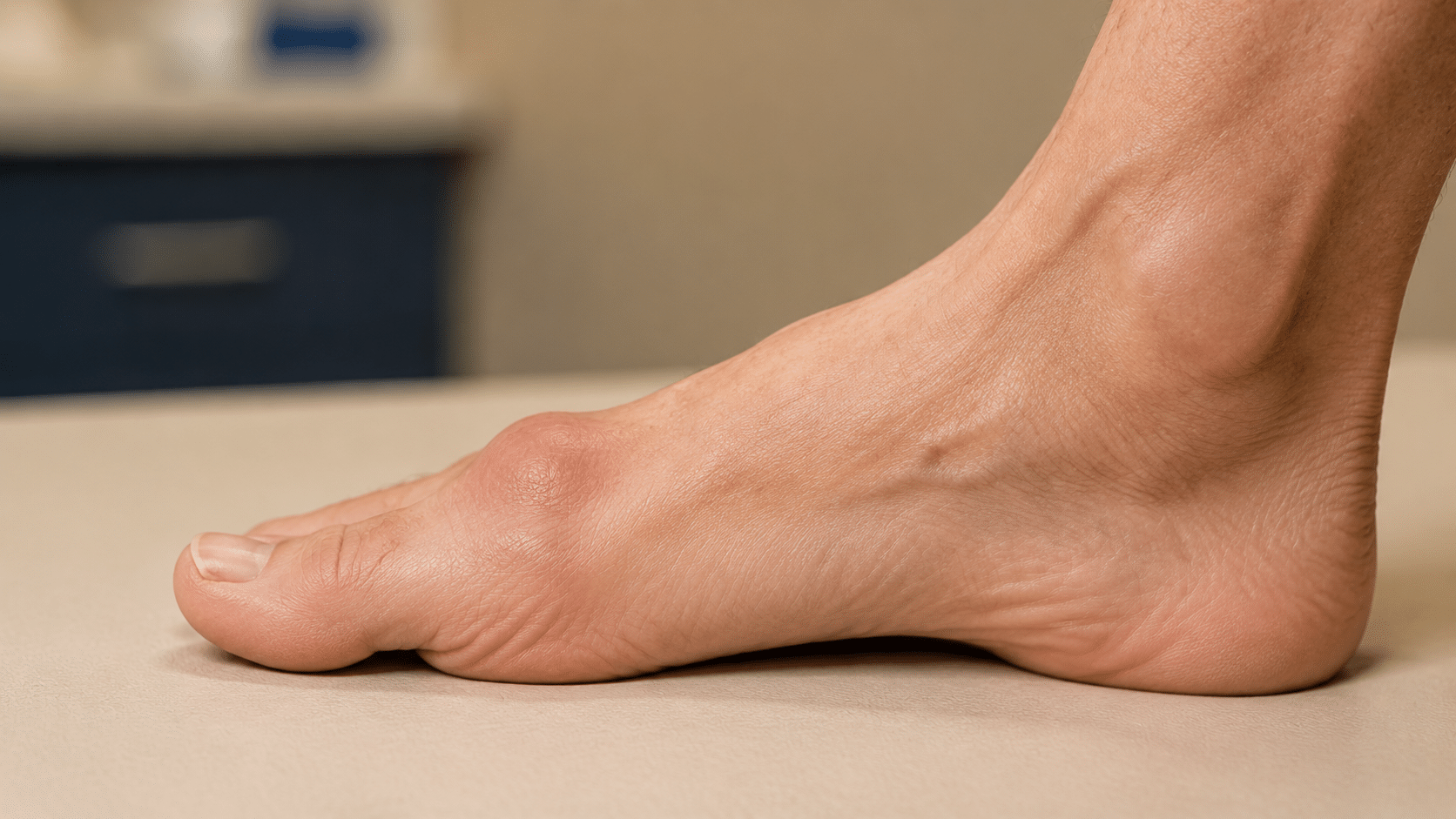
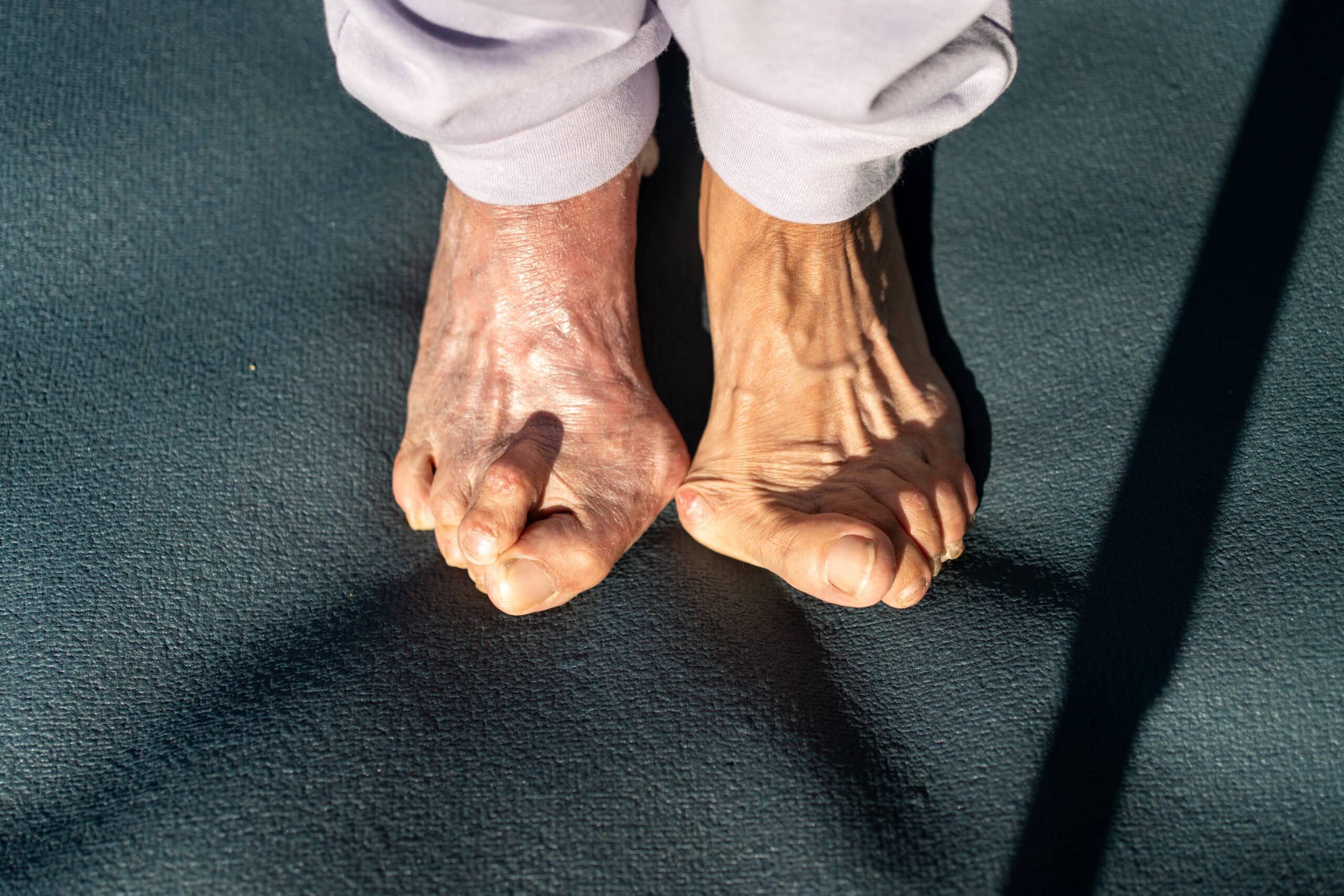
A bunion is a structural change in the alignment of the first metatarsophalangeal joint—the joint at the base of the big toe. [See- why bunions develop and how foot mechanics influence progression]
Over time, the bones gradually move out of alignment. The visible prominence along the inside of the foot is only one part of that process.
As the mechanics change, patients may experience irritation over the bump, difficulty fitting into shoes, pain around the great-toe joint, crowding of the lesser toes, transfer pressure beneath the forefoot, or changes in the way they walk.
Bunions usually develop gradually and can progress over time, although the rate of progression varies considerably from person to person.
That means two people with similar-looking X-rays may have completely different problems.
One may have very little discomfort and almost no functional limitation.
Another may have changed her shoes, exercise, travel, and daily routine around the same-looking deformity.
The X-ray helps me understand the structure.
The patient tells me whether the structure has become a problem worth solving.
When Waiting Still Makes Sense
Having a bunion does not automatically mean you need surgery.
If the bunion is not significantly affecting your comfort, function, footwear, activity, or quality of life, observation may be completely reasonable.
Nonsurgical treatment can often reduce pressure and improve comfort. Depending on the individual patient, this may include footwear changes, padding, orthotic support, activity modification, toe spacers, or other measures designed to reduce irritation and improve mechanics.
These treatments can be very useful.
What they generally cannot do is permanently reverse the underlying bony deformity once it has developed.
That distinction matters.
Sometimes the right goal is management.
Sometimes the right goal is correction.
My job is not to convince every person with a bunion to have surgery.
My job is to help determine which problem we are actually trying to solve.
The Signs That You May Be Crossing the Threshold
For many patients, the decision point is not dramatic.
It is the accumulation of small things.
You may be getting closer to that threshold if:
- You are choosing shoes around your bunion rather than choosing the shoes you actually want to wear.
- Walking farther has become something you think about before committing to it.
- Exercise has been reduced or modified because of your foot.
- Travel requires more planning because you are worried about how much walking will be involved.
- You avoid certain events because you know your foot will hurt afterward.
- You regularly compensate for the painful area and begin developing discomfort somewhere else.
- The deformity is becoming more prominent or is beginning to crowd neighboring toes.
- You have tried reasonable nonsurgical options, but the same problem keeps returning.
- You find yourself saying, “I can still deal with it,” while simultaneously organizing more and more of your life around it.
That last one is important.
Being able to tolerate a problem is not the same thing as being unaffected by it.
And you do not necessarily have to wait until your bunion completely stops you before asking whether there is a better option.
But What If the Real Reason You Are Waiting Is the Surgery?
This is where the conversation changes.
Many of the patients I meet already know their bunion bothers them.
They know they would like to wear different shoes.
They know walking would be easier without it.
They know they are tired of planning around their foot.
But none of that is the real reason they have waited.
They have waited because they are afraid of what fixing it will require.
They picture:
Weeks without walking.
Crutches.
A large incision.
Significant pain.
Permanent hardware.
Months before getting back into a shoe.
Time away from work.
Giving up exercise.
Needing someone else to take care of them.
In other words:
They are afraid surgery will take even more from their life than the bunion already has.
If that is the picture you have in your mind, waiting can feel completely rational.
But the surgery you are imagining may be very different from the surgery I would design for you.
Foot Surgery Does Not Have to Mean Putting Your Life on Hold
I focus my surgical practice on minimally invasive forefoot reconstruction because I believe the burden of the treatment matters.
The goal is not simply:
Can I correct the bunion?
It is also:
How much surgery is actually necessary to achieve the patient’s goal?
How much tissue needs to be disrupted?
How can the correction be stabilized?
How soon can the patient safely walk?
What will work require?
When can they drive?
When can they begin transitioning back into shoes?
What does this person need to return to?
Those questions belong in the surgical plan from the beginning.
That is also why I do not think of recovery as something that starts after surgery.
We design for recovery before the operation ever begins.
This Is Where PRISM™ Fits In
I developed the PRISM™ Reconstruction System because I did not believe the operation itself should be treated as the entire treatment.
PRISM is the way I approach the complete surgical journey.
Not as an add-on.
Not as a collection of optional technologies.
And not simply as “minimally invasive surgery.”
It is a system built around three fundamental questions:
ROOT → FIX → HEAL
ROOT: Why did the problem develop?
Before deciding how to correct a bunion, I want to understand the mechanics of the entire forefoot.
What is driving the deformity?
Where is the pressure going?
How is the big toe functioning?
What are the lesser toes doing?
How has the patient been compensating?
What does this person actually want to return to?
The right outcome starts with understanding where we need to go.
FIX: What correction is actually necessary?
Once I understand the root problem and the patient’s destination, I can design the correction.
That may involve repositioning bone, restoring alignment, addressing soft-tissue imbalance, improving joint function, or correcting associated forefoot deformity.
The goal is not to perform the biggest correction I can defend on an X-ray.
It is to perform the appropriate correction for the problem we are trying to solve.
More surgery is not automatically better surgery.
The improvement should justify what the patient has to go through to achieve it.
HEAL: How do we create the best recovery environment we reasonably can?
The operation determines what has to heal.
But the operation is not the only thing that influences the recovery trajectory.
Healing reflects the interaction of three major variables:
The structural healing demand of the procedure.
The patient’s underlying biological capacity to heal.
The recovery system we design around them.
That final piece is where PRISM extends beyond the operation.
Recovery is deliberately supported through the way the correction is performed, how the foot is stabilized, how healing is monitored, how biology is supported, how activity progresses, and how mechanics are restored as the patient moves back toward normal life.
[ Learn more about the PRISM™ Reconstruction System]
What Can Recovery Actually Look Like?
This is where I believe patients deserve both confidence and honesty.
I can be very confident about the patterns I consistently see in my practice without pretending that every patient is the same.
My bunion procedures are designed around immediate protected walking.
To date, every bunion patient I have treated with this minimally invasive approach has been able to walk immediately after surgery.
That does not mean the foot is healed immediately.
It does not mean there is no swelling.
And it does not mean the patient leaves surgery and resumes unrestricted activity.
It means we are starting the recovery from a very different place than the prolonged non-weight-bearing experience many patients fear.
Across the forefoot procedures I perform, more than 90% of patients transition back into shoes within approximately 2–4 weeks.
Some are ready toward the earlier end.
Others need closer to four weeks.
And some patients appropriately take longer.
I do not guarantee any individual patient a particular recovery date.
[ Learn more about healing after foot surgery]
Because recovery is not determined by surgery alone.
A relatively simple correction does not create the same healing demand as a more complex reconstruction.
A healthy patient with strong baseline healing capacity does not necessarily follow the same trajectory as someone with meaningful biological barriers.
And the intensity of the recovery program can materially influence the recovery patterns I observe.
That is why I prefer to talk about designed recovery, rather than “fast recovery.”
The objective is not to race biology.
It is to optimize the things we can influence while respecting the things we cannot.
[What Life After Foot Surgery Can Look Like]
The Goal Is Not Surgery
This may be the most important part of the entire decision.
When someone sits down with me, I am not primarily asking:
“What operation does this bunion need?”
I am asking:
“Where is this patient trying to go?”
Maybe she wants to travel without wondering whether the itinerary involves too much walking.
Maybe she wants to return to tennis.
Maybe she wants to exercise without thinking about her foot.
Maybe she wants to wear the shoes she stopped wearing years ago.
Maybe she simply wants to get through a normal day without her bunion constantly entering the conversation.
The destination determines the route.
That is why two people with similar bunions may receive very different recommendations.
A successful surgery is not simply an X-ray with better angles.
A successful surgery is one that meaningfully solves the problem the patient came in asking me to solve.
[Read – Questions worth asking before foot surgery]
When Is It Time to Act?
There is no universal number on an X-ray that tells you when it is time.
There is no specific pain score.
There is no birthday at which surgery suddenly becomes appropriate.
Instead, I would ask yourself a few different questions:
What has my foot caused me to stop doing?
What have I started planning around?
What am I tolerating today that I would not have accepted several years ago?
Am I treating the problem—or simply adapting around it?
If I knew the recovery could be less disruptive than I have imagined, would I look at the decision differently?
That last question often opens the door to a much more useful conversation.
Because sometimes the decision is not:
“Am I ready for bunion surgery?”
It is:
“Is the bunion surgery I am afraid of actually the surgery I would need?”
When Waiting Is the Right Answer
Sometimes, after evaluating everything, my recommendation is still to wait.
That is not a failure to act.
It is a decision.
If the expected benefit does not justify the treatment burden, we should not operate simply because we can.
If nonsurgical care is keeping you comfortable and allowing you to live the life you want, continuing that approach may be completely appropriate.
If your biology creates barriers that meaningfully change the risk or expected recovery, those factors have to be respected.
And if you simply are not ready, that matters too.
Elective surgery should make sense for the individual patient.
When Moving Forward Makes Sense
The conversation changes when the problem has crossed the threshold where it is meaningfully affecting your life—and there is a correction whose expected benefit justifies what you will need to go through.
That is where surgical judgment matters.
Not simply knowing how to operate.
Knowing when, why, and how much to operate.
And then designing the recovery with the same level of intention as the correction itself.
If You Have Been Waiting Because You Are Afraid of the Recovery
You are not alone.
Many patients arrive expecting foot surgery to be far more disruptive than the experience I ultimately design for them.
That does not mean recovery disappears.
It means there may be a very different way to approach it.
A different way to correct the problem.
A different way to think about healing.
And a different way to plan the journey back to the life you want.
[Read a patient’s PRISM™ Recovery Story — “I Thought Surgery Would End My Running”]
The first step does not have to be deciding to have surgery.
It can simply be understanding your options.
Because once you know what your particular correction and recovery would actually involve, you can make the decision based on your foot, your life, and your goals—rather than the surgery you have been imagining.
Ready to Understand Your Options?
If your bunion has started changing the way you walk, exercise, travel, dress, work, or live—and fear of recovery is the reason you have kept putting it off—the next step is not automatically surgery.
It is a thoughtful evaluation.
We can look at the mechanics of your foot, understand what the problem is actually taking from you, discuss what can reasonably be corrected, and determine what recovery would likely require in your individual case.
Then you can decide whether now is the right time.
The goal is not simply to fix a bunion.
The goal is to help you get back to the life your foot has been quietly taking away.
[Read Dr Tagge’s approach to minimally invasive forefoot reconstruction]
Frequently Asked Questions About Bunions and Bunion Surgery
How do I know when my bunion is bad enough for surgery?
There is no single X-ray measurement or pain score that determines when a bunion is “bad enough.”
The decision should consider the entire picture: pain, shoe limitations, walking, activity, progression of the deformity, changes in neighboring toes, and how much you have begun adjusting your life around the foot. Surgery is generally considered when symptoms and functional limitations persist despite reasonable nonsurgical treatment.
Sometimes the signal is significant pain.
Sometimes it is realizing how many things you have quietly stopped doing.
The important question is not simply:
“Can this bunion be corrected?”
It is:
“Would the expected improvement justify what I would need to go through to correct it?”
Should I wait until my bunion becomes extremely painful?
Not necessarily.
Pain matters, but it is not the only way a bunion can affect your life.
You may still be functioning while gradually changing your shoes, shortening walks, modifying exercise, avoiding activities, or planning travel around what your foot will tolerate.
Professional guidance generally recommends discussing surgery when bunion symptoms interfere with walking or daily activities despite appropriate nonsurgical measures.
That does not mean everyone who notices a lifestyle change should have surgery.
It means you do not have to wait until your foot completely stops you before understanding your options.
Do bunions always get worse?
Bunions are progressive structural deformities, but they do not progress at the same rate in every person.
Some change very slowly over many years. Others become symptomatic or visibly progress more quickly. Both AAOS and the American College of Foot and Ankle Surgeons describe bunions as progressive conditions whose course varies between patients.
That is one reason an evaluation can be useful even when surgery is not yet appropriate.
The goal may simply be to understand where you are today and what trajectory the foot appears to be following.
Can a bunion be corrected without surgery?
Nonsurgical treatment can often make a bunion more comfortable.
Wider shoes, padding, orthotic support, activity modification, and other conservative measures may reduce irritation or improve how the foot functions. But once a structural bunion deformity has developed, nonsurgical care does not permanently realign the bones.
That distinction is important.
Sometimes the appropriate goal is management.
Sometimes the appropriate goal becomes structural correction.
Not every patient with a bunion needs surgery.
What happens if I wait too long?
There is no universal point where every bunion suddenly becomes “too late” to correct.
However, bunions can progress over time and may eventually contribute to increasing shoe difficulty, pain with walking, crowding of neighboring toes, and altered mechanics across the forefoot.
An earlier evaluation does not necessarily mean earlier surgery.
Sometimes it simply gives you perspective.
You can understand what is changing, what is not, what options are available, and whether continuing to wait still makes sense for your foot and your life.
Will I be able to walk after minimally invasive bunion surgery?
My bunion procedures are designed around immediate protected walking.
To date, every bunion patient I have treated with my minimally invasive approach has been able to walk immediately after the procedure in prescribed protective postoperative footwear.
That does not mean the foot is healed immediately.
There is still swelling. Bone and soft tissue still need time to heal. Activity remains controlled and progresses according to the correction performed and the individual patient.
The important distinction is that, in my practice, recovery begins with protected mobility rather than automatically beginning with prolonged non-weight-bearing.
Your individual surgical and recovery plan is determined during your evaluation.
How long does it take to get back into a regular shoe?
Across the forefoot procedures I perform, more than 90% of my patients transition back into shoes within approximately 2–4 weeks.
Not everyone is ready at two weeks.
Some patients are closer to four weeks, and some appropriately require longer.
I do not promise an individual patient a particular shoe date because recovery depends on three major variables:
1. What had to be corrected.
A smaller correction and a more extensive reconstruction create different healing demands.
2. Your underlying capacity to heal.
Baseline health and biology can create real limitations that have to be recognized rather than ignored.
3. The recovery program designed around the procedure.
The level of recovery support can materially influence the recovery trajectory I observe.
The goal is not to race biology.
It is to create the best recovery environment we reasonably can while respecting what your particular foot needs to heal.
Is PRISM™ the same thing as minimally invasive surgery?
No.
Minimally invasive surgery describes how I perform the structural correction.
PRISM™ describes how I approach the entire treatment process.
The PRISM™ Reconstruction System begins by understanding the root mechanical problem and what the patient is trying to get back to.
Then we design the appropriate correction and coordinate the healing, stability, mechanics, recovery planning, and physician-directed support around it.
A simple way to think about it is:
ROOT → FIX → HEAL
ROOT — Understand why the problem exists and what it is doing to your life.
FIX — Perform the appropriate minimally invasive correction without creating unnecessary treatment burden.
HEAL — Deliberately support recovery, stability, biology, and mechanics as you return to activity.
Minimally invasive surgery is an important part of the system.
PRISM™ is the complete framework around it.