The First Active Weekend May Not Have Created the Problem
The first warm weekend is a familiar version of the story: active adults return to longer walks, gardening, golf, tennis, running, and weekends spent on the sidelines of children’s sports. When the forefoot starts hurting, the sudden increase in activity seems like the obvious cause.
Sometimes the increased activity creates a genuinely new injury or inflammatory flare. Sometimes it is simply a load error: too much, too soon, after a quieter period. But activity can also expose a structural or mechanical problem that lower daily demand had kept quiet.
The clinical question is not only, “What did I do this weekend?” It is also, “Why did this area become symptomatic when the demand increased?”
Load Exposes Capacity
Bone, tendon, joint, and soft tissue respond to repeated load, while nerves may become irritated or compressed as pressure patterns change. When weekly activity rises abruptly, tissue demand can exceed current capacity. Rest and a gradual return may solve a straightforward overload problem.
But repeated pain in the same location, swelling around a joint, burning into the toes, loss of big-toe motion, or a callus under one metatarsal suggests that the load may be revealing an underlying mechanical pattern.
The “I’m Still Functioning” Trap
Many capable adults have been accommodating the foot long before it becomes painful enough to name. They choose the more supportive shoe, park closer, skip the longer walk, stand on the other leg, or stop doing an activity they once enjoyed.
Spring does not always mark the beginning of the problem. It marks the moment the adaptation stops being sufficient.
That matters because the correct response is not necessarily to stop being active. It is to identify whether the limiting factor is temporary conditioning, an irritated tissue, or a structural problem that continues redirecting force.
Where the Pain Occurs Changes the Conversation
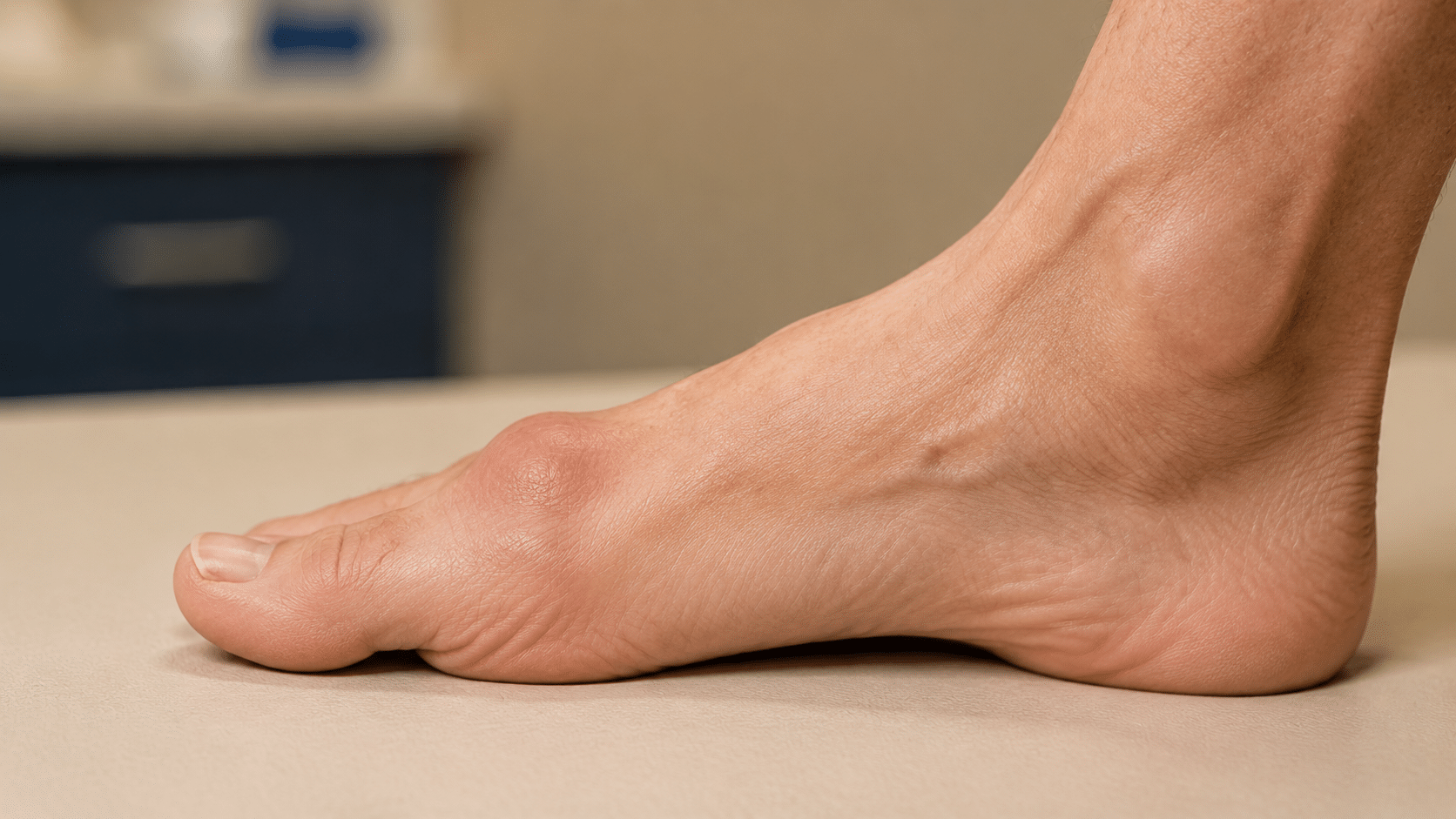
Pain over a bunion prominence is different from pain inside the big-toe joint. Burning in the third interspace suggests a different pathway from tenderness beneath an unstable second toe. Lateral forefoot pain from a bunionette may lead to a compensation that increases pressure medially.
The location, timing, footwear relationship, swelling, motion, and activity pattern help determine whether the first step is load modification, footwear, mechanical support, targeted recovery care, imaging, or a surgical discussion.
When to Give It Time
A brief period of reduced load and gradual progression can be reasonable when symptoms are mild, clearly linked to an abrupt increase, and steadily improving. The goal is to restore capacity, not to punish the foot with total inactivity.
When Not to Keep Repeating the Same Reset
An evaluation becomes more useful when pain returns every time activity increases, the foot is visibly changing, a toe is drifting or crossing, joint motion is decreasing, burning or numbness persists, or the problem is shrinking the life you are trying to resume.
Repeatedly calming symptoms without understanding the mechanical trigger can turn every new season into the same cycle.
Acute trauma, inability to bear weight, marked swelling, redness or warmth, an open wound, fever, or progressive numbness or weakness should not be treated as a routine training flare. Those findings warrant timely medical evaluation.
Stay Active by Understanding the Root Problem
The goal is not to tell an active patient to stop. It is to decide what the foot needs in order to tolerate the life the patient wants.
For some, that is a smarter progression and a better shoe. For others, it is targeted regenerative treatment or mechanical support. When a structural deformity has become the limiting factor, minimally invasive correction may create a different path back to activity.
If spring activity has exposed bunion pain, begin with the Complete Bunion Decision Guide. If the pain is burning, numb, or centered between the toes, continue to the Morton’s Neuroma Treatment guide. If several areas are interacting or you are investigating regenerative treatments, a discovery call can help direct you to the right evaluation.